Atiku, Lyon and the Rule of Law: When the Verdict Changes, Should the Principle?
Original analysis compares Atiku’s 5 November 2026 ADC response with his 13 February 2020 Bayelsa reaction, separating legal differences from political rhetoric.
Civique News Editorial Board · 12d ago
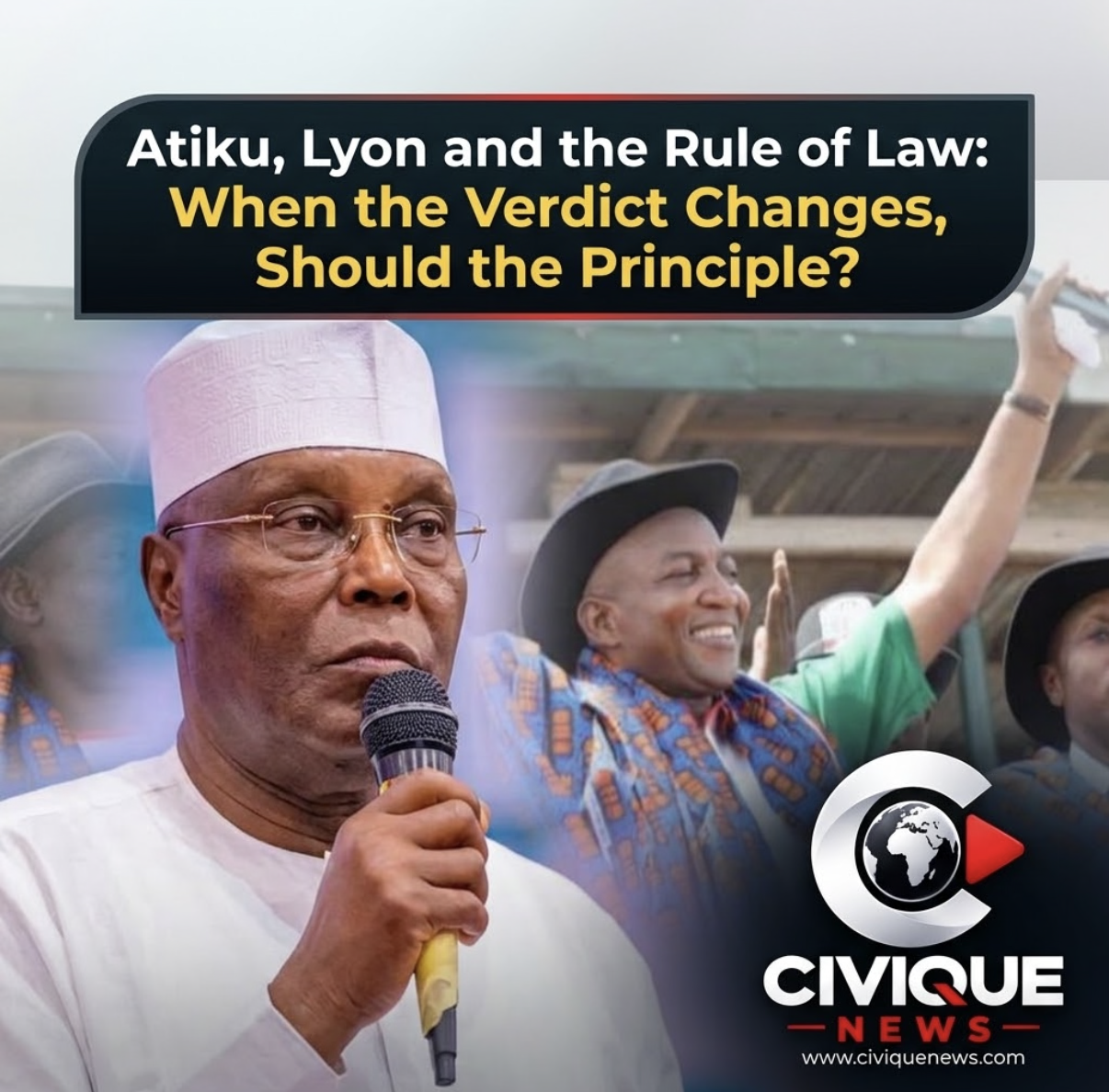
ORIGINAL ANALYSIS / EDITORIAL — This is Civique News’s assessment of dated public statements and reported court decisions, not an exclusive interview or a claim of newly discovered evidence. Quotations are attributed to published reports; the editorial conclusions are our opinion.
Atiku Abubakar’s response to the court decision affecting his African Democratic Congress nomination raises a question larger than one candidate’s campaign: do Nigerian politicians defend institutions consistently, or does their language change when the result stops favouring them? His latest substantive response verified for this article, issued on 5 November 2026, can be compared with his welcome for the Bayelsa judgment on 13 February 2020. But the legal differences between those cases matter just as much as the political contrast.
5 NOVEMBER 2026: WHAT ATIKU SAID
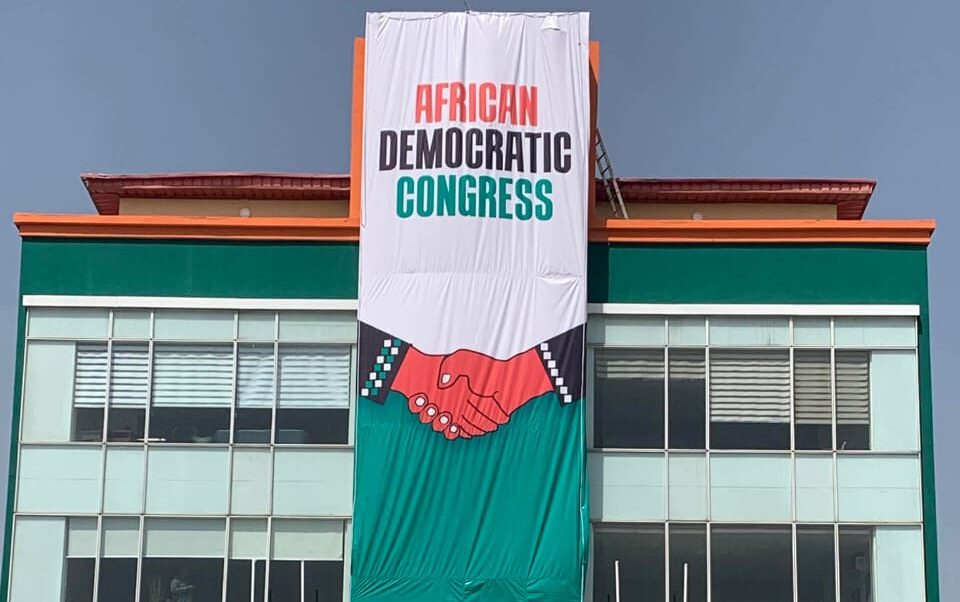
The Federal High Court in Abuja, presided over by Justice Peter Lifu, was reported to have invalidated the David Mark-led ADC leadership and decisions taken under it, including the presidential nomination of Atiku. The challenge concerned how the leadership emerged after Ralph Nwosu’s departure; former deputy national chairman Nafiu Bala Gombe asserted that he was entitled to succeed him. This account relies on published reporting, not an independent reading of the certified judgment.
In a statement issued through Phrank Shaibu, the campaign’s Director of Strategic Communication, Atiku said: “The timing of this judgment is no coincidence. It is part of a strategy to weaken my support in the North and frustrate a campaign whose message is resonating across the country.” Premium Times and THISDAY reported those words on 5 November. His allegation of a political strategy is not independently established fact.
He also referred to an earlier ruling involving the party and said: “Why, after that judgment, was another case filed to reopen the same dispute? This is a calculated attempt to circumvent a subsisting judgment. We will challenge this judicial manoeuvre at the Court of Appeal.” Premium Times cautioned that the cases involved different claimants and that it had not examined both judgments to establish conflicting orders. We therefore do not assert that one judge unlawfully overturned another, or that APC interference has been proved.
ARISE reported on 6 November that an appeal and an application for a stay of execution had been filed and communicated to INEC. It quoted the campaign as saying the stay application had not yet been determined. This article has not established a later order granting a stay as of publication on 10 November. An appeal is not, by itself, a suspension or reversal of a judgment.
13 FEBRUARY 2020: THE BAYELSA CONTRAST
Six years earlier, Atiku’s tone was markedly different when a court outcome benefited the PDP. On 13 February 2020, the Supreme Court disqualified APC deputy-governorship candidate Biobarakuma Degi-Eremienyo over false information concerning his educational qualifications submitted to INEC. The disqualification affected the joint ticket he shared with David Lyon, whose inauguration had been scheduled for the next day.
The election had taken place on 16 November 2019. The Supreme Court directed INEC to withdraw the APC candidates’ certificates and issue fresh certificates to the candidates with the next-highest votes and the required constitutional spread. The legal defect concerned the deputy candidate’s qualifications and the joint ticket; it was not a finding that Lyon personally committed the deputy’s wrongdoing, nor a declaration that Douye Diri had originally won the largest raw vote total.
Atiku welcomed the outcome “with gladness”, according to same-day reporting in Daily Post and a reproduction of his social-media statement by Information Nigeria. He congratulated Diri and his running mate, Lawrence Ewhrujakpor, and said: “The Lords Justices have given us another opportunity to show Nigerians that power belongs to the people, and we must make good use of this opportunity.”
A fair comparison must include the qualification in that same 2020 statement. Atiku also urged the Supreme Court to be consistent and deliver just judgments “no matter whose ox is gored”. He called on Bayelsa residents to make peace with the recent past and embrace the future together. Omitting that demand for consistency and appeal for peace would distort his position.
SIMILAR POLITICAL CONSEQUENCES, DIFFERENT LEGAL CASES
Both decisions disrupted an anticipated political path because of a legal challenge. Beyond that, they are not interchangeable precedents. Bayelsa involved a Supreme Court decision on a deputy candidate’s qualifications and a joint governorship ticket after an election. The ADC dispute concerns party leadership and nomination, at Federal High Court level, with an appeal available. A politician can reasonably welcome one decision and contest another if the legal grounds differ.
Nor does exercising a right of appeal amount to rejecting the rule of law. Courts can make errors; appeals exist to correct them. Our concern is the leap from identifying a specific legal error to declaring an institution captured or politically manipulated without publicly demonstrating that allegation. The standard politicians demanded when opponents lost should also guide their words when they lose.
THIS IS NOT A ONE-PARTY PROBLEM
The public record offers other contrasts. In a statement published by Vanguard on 28 December 2011 after the Supreme Court rejected the CPC challenge to Goodluck Jonathan’s election, Muhammadu Buhari said the decision was “politically motivated and has little judicial content”. He criticised INEC chairman Attahiru Jega, saying that a man presented as competent and possessing integrity had “proved neither”. Those were Buhari’s accusations, not findings adopted here.
After his own victory, Buhari’s acceptance statement published on 1 April 2015 described INEC’s official announcement as “the moment the vast majority of Nigerians had hoped and been waiting for”. He added: “Today, history has been made, and change has finally come.” That illustrates a stark difference in the reception of adverse and favourable outcomes. It does not prove that he expressly withdrew every earlier criticism, or that the conduct of the two elections was identical.
The 2023 presidential litigation provides another documented juxtaposition. On 26 October 2023, the Supreme Court upheld Bola Tinubu’s election. Reuters quoted Tinubu’s response: “We are all members of one household, and this moment demands that we continue to work and build our country together.” The winner emphasised unity and moving forward.
Four days later, on 30 October, Atiku’s press conference took a much harsher view of the same outcome. In the text published by Punch, he said: “If the Supreme Court, the highest court in the land, implies by its judgment that crime is good and should be rewarded, then Nigeria has lost and the country is doomed irrespective of who occupies the Presidential seat.” That is his conditional accusation; it is not a finding by this article that the court endorsed crime.
These examples demonstrate contrasting rhetoric around outcomes. They do not establish that every party behaves identically, that every institutional criticism is unjustified, or that these speakers instructed supporters to attack judges or electoral officials. Claims that a particular politician organised violence require separate evidence. The responsible argument is that leaders must avoid turning disputed allegations into sweeping messages that destroy public confidence without a clear evidential basis.
AMAECHI’S WARNING: QUOTE IT FAIRLY, CHALLENGE IT RESPONSIBLY
Vanguard’s report published on 8 November attributes this warning about the ADC ruling to Rotimi Amaechi in a Mainland 98.3 FM interview: “It could cause a civil war if not properly managed.” The same quoted passage immediately adds that he met party leaders and said: “please, lower the tempo”.
It would be inaccurate to erase the call for calm and describe the passage as a proven threat to start a civil war. It also does not establish that Amaechi caused deaths or property destruction. The exact broadcast date was not independently confirmed here; 8 November is the report’s publication date.
Even with that qualification, our editorial position is that invoking civil war in an electoral dispute is unnecessarily combustible. Leaders can warn about tensions without presenting catastrophe as the natural response to litigation. Every public statement should make nonviolence unmistakable and direct supporters towards lawful remedies. Citizens must not become collateral damage in contests over office.
PROACTIVE LEADERSHIP, NOT EMOTIONAL MOBILISATION
The practical alternative is more demanding than a slogan. Parties should verify qualifications early, document lawful leadership transitions, audit nomination procedures, obtain timely legal advice, preserve records and prepare appeals around specific errors. Tactical and strategic preparation means preventing avoidable vulnerabilities where possible, rather than relying on public anger after a dispute arises. We do not claim the ADC’s negligence has been judicially established merely because its leadership lost this case.
Solution-driven politics also means publishing the relevant orders, explaining what relief has been sought and correcting supporters who mistake a pending appeal for a victory. Where electoral or judicial wrongdoing is alleged, leaders should identify the evidence, pursue the proper complaint or appeal and demand proportionate remedies. Criticism and peaceful protest remain legitimate; threats and attacks do not.
Sportsmanship does not require surrendering a credible legal challenge. It requires applying the same standards to allies and opponents, rejecting violence even when emotions are high, and respecting operative decisions unless lawfully stayed or overturned. Nigerian politicians need to do better by setting a proper precedent for the people they seek to lead.
Do we really believe in the rule of law in Nigeria, or do we uphold it when it favours us and kick against it when it does not? The answer should be visible in conduct, not just victory speeches: consistency, lawful challenge, strategic preparation and an unequivocal refusal to mislead citizens into hostility towards institutions or one another.
SOURCES AND DATES — These reports underpin the factual chronology and quotations; the comparisons and recommendations above are Civique News editorial opinion.
Premium Times, 5 November 2026: https://www.premiumtimesng.com/news/top-news/923035-atiku-vows-to-appeal-court-judgement-against-his-candidacy-seeks-stay-of-execution.html
THISDAY, 5 November 2026: https://www.thisdaylive.com/2026/11/05/atiku-reacts-to-court-judgement-accuses-apc-of-plotting-to-weaken-adc-frustrate-his-candidacy/
ARISE News, 6 November 2026: https://www.arise.tv/adc-appeals-judgment-voiding-atikus-candidacy-notifies-inec/
Punch, 13 February 2020: https://punchng.com/breaking-supreme-court-nullifies-bayelsa-governor-elects-election-declares-pdp-winner/
Daily Post, 13 February 2020: https://dailypost.ng/2020/02/13/apc-vs-pdp-atiku-reacts-as-supreme-court-sacks-bayelsa-gov-elect-lyon/
Information Nigeria, 13 February 2020: https://www.informationng.com/2020/02/bayelsea-atiku-reacts-as-supreme-court-sacks-david-lyon.html
Vanguard, 28 December 2011: https://www.vanguardngr.com/2011/12/scourt-judgment-buhari-reacts/
THEWILL, 1 April 2015: https://thewillnews.com/buhari-receives-certificate-of-return-from-inec/
Reuters, 26 October 2023: https://www.reuters.com/world/africa/nigerian-supreme-court-upholds-president-tinubus-election-win-2023-10-26/
Punch, 30 October 2023: https://punchng.com/full-text-atikus-press-conference-on-scourt-verdict/
Vanguard, 8 November 2026: https://www.vanguardngr.com/2026/11/adc-judgment-could-cause-civil-war-if-not-properly-managed-amaechi/
YOUR TAKE?
FOLLOW @CIVIQUENEWS
Get breaking news first. Follow us on X, Instagram, Threads and join our WhatsApp channel.
GOT A TIP? GOT VIDEO?
Saw something happen? Send us your photos, video or story. Your name stays private.